Showing posts sorted by relevance for query casino historic. Sort by date Show all posts

Thursday, August 20, 2015

Historic Boynton Beach High School and the former historic Lake Worth Casino Building: the problem with comparing the two structures

Many parallels do exist between the historic Boynton Beach High School and the former Lake Worth Casino building that was demolished. Each building represents a touchstone to the past of both communities and each has had to grapple with how best to renovate (or not renovate) and reuse these publicly owned buildings over time. Both publicly-owned buildings found themselves used as political footballs as the emotion to save and honor them became enmeshed with how to pay to save them.

Both have experienced the failure of various public/private partnerships that have cost both cities money to defend themselves from lawsuits. Lake Worth had to pay to defend itself from a lawsuit filed by Greater Bay and eventually paid out $1.6 million to settle the lawsuit. Boynton Beach is in a similar fight with the latest attempt to redevelop the site/building to a more commercial use and the prospects do not look good.

The Boynton Beach High School sits very near the city's municipal complex and carries a public zoning designation. Below is a video made up of photos I took of the building back in 2014. Notice the zoning and land use change sign. The city is not following through on the zoning of the property which is the basis for the current lawsuit.

Now, Rick Gonzalez, another common element the two buildings share, is back on the scene attempting to save the high school. All we can do is hope his efforts don't take the same road as the Lake Worth Casino complex which was 94% demolished (more on this below).

Here is a link to the Alexandra Seltzer article, curiously published on same day as the letter to editor by Mr. Gonzalez. Both the letter and the news article were published the day after the Boynton Beach City Commission agreed to hold off on the demolition of the building. . .for now.

Here is the Post letter to the editor:
Boynton wrong to raze historic high school
As immediate past president of the Florida Trust for Historic Preservation. and current vice chairman of the Florida Historical Commission, I was appalled to hear of the decision by the Boynton Beach City Commission to demolish the old Boynton Beach High School.
This building has been designated by the trust as one of Florida’s historic buildings and, as such, has been placed on the “Most Endangered List” by the organization. To demolish it would be a huge loss to our historic local and state heritage. 
How could commissioners come to this devastating decision? Perhaps they are unaware of the current trend in urban planning to renovate buildings of historic significance to use as anchors for community and private-sector hubs. The city of West Palm Beach is an example of this, where we restored the old Palm Beach County Courthouse to become the centerpiece of the Governmental Center.
The city of Lake Worth has also mastered this concept, where we rebuilt the historic Lake Worth Casino, which now has a community ballroom as well as restaurants and retail establishments. Why can’t Boynton Beach do the same with the old high school?
Why would the commission vote to demolish the school with no clear plan for public or private use for the site? There are developers out there that have proven track records at using historic buildings as anchors for civic and business centers. However, it takes the foresight of those in government to pursue these companies.
RICK GONZALEZ, WEST PALM BEACH
Editor’s note: Rick Gonzalez is president of REG Architects Inc.
Mr. Gonzalez is correct in saying that the City of Lake Worth "rebuilt" the Lake Worth Casino; but during his "pitch" to the City Commission at the time, it was all about saving the building. This is how the city saved the Casino building:

Our historic Casino building was not saved. It disappeared. This is what it looked like during the middle of 2011.
 Pictures taken at the peak of former historic Lake Worth Casino building during its demolition.
Now Lake Worth has a building with acknowledged construction and design flaws that impede its ability to be self-sustaining financially and to be a real community asset. If you have been to our Commission meetings, every now and then you hear discussion between the City, architect and contractor's attorneys. So we are not over this "rebuild" yet.

I wish the best of luck to those attempting to save this historic building in Boynton Beach, while it still is around to save. Doing so would be real historic preservation. What Lake Worth did cannot be called historic preservation. We tore down a National Register eligible building and built a new one in its place. One that is functionally flawed and an albatross for the City and its residents.

Monday, May 21, 2018

Press Release: 2nd Annual Historic Preservation Awards ceremony in the City of Lake Worth is this Wednesday.


[Press Release is below. But first, please take note: The Lake Worth Casino IS NOT a historic structure. Hopefully some day the Historic Preservation Awards will be held in the lobby of the Gulfstream Hotel, a structure of true historic significance.The Casino structure presently at the Lake Worth Beach is new construction, a $6M replica of past Casino’s from our Citys long history.

Just to be clear. There is not one single structure at the Beach that is historic any more except for the historic arguments going back over a hundred years about what to do with that 19 acres at the Beach. To find out exactly what is listed on the National Register and the City’s “Register of Historic Places” click on this link.]


For more information about Wednesday’s ceremony contact Mr. Ben Kerr, the City’s Public Information Officer at 561-586-1631; email: BKerr@lakeworth.org
May is National Historic Preservation Month. Share this upcoming event using hashtag #ThisPlaceMatters

Press release follows:


Lake Worth, FL* — On May 23rd, 2018 at 7:00 p.m. the City of Lake Worth, Department for Community Sustainability, Division of Planning, Zoning and Historic Preservation in conjunction with the Historic Resources Preservation Board and the Historical Society of Lake Worth will host a ceremony in the Lake Worth Casino Ballroom to present the second annual Lake Worth Historic Preservation Awards.

Winners will be recognized with awards in five categories:
  • Rehabilitation/restoration.
  • Compatible new construction or addition.
  • Preservation of historic materials.
  • Preservation craftsman.
  • Preservation champion or organization.

The Historical Society of Lake Worth will also be presenting two awards for sensitive restoration and adaptive re-use of historic properties. After the ceremony a light reception will be held.

“The City of Lake Worth Historic Resources Preservation Board is pleased to announce the City’s second annual Historic Preservation Awards. I hope you’ll join us in recognizing the award winners that have contributed to preserving our City’s unique character and the people that helped make it possible. We are excited to continue with the annual awards program as there are many great new projects in the City.”

—Darrin Engel, Chairman of the Lake Worth Historic Resources Preservation Board.


*We are LAKE WORTH. A hometown City that is committed to delivering the highest level of customer service through a commitment to integrity, hard work and a friendly attitude. We strive to exceed the expectations of our citizens, our businesses, our elected officials and our fellow employees.”

Monday, January 19, 2009

Part II: The Three "Rs" of Historic Preservation - New Beach Plan

Part I was a reflection on the "new" beach and casino building redevelopment plan. This Part II deals with how or if we can really term the work on the casino building contemplated by Straticon et al as "historic preservation." At one City Commission meeting, the elected ones talked about the possibility of historic preservation grants for the project. Not so fast - I think this project would have real problems competing for grant funds.

Many of you probably know that I am not a stranger to historic preservation. From early on in my planning career, I worked on documenting historic districts and acted as an advocate for historic preservation wherever I lived. In 1993, that passion reached full flower when I supported the preservation of the Mar-a-Lago estate and was soon hired on to organize the restoration, rehabilitation of the estate in converting it to an adaptive re-use - that being a private, non-discriminatory club in the Town of Palm Beach.

In that capacity, one of the projects we undertook was the construction of two cabana buildings and a pool on the one acre "beach" portion of the estate. During Mrs. Post's day, she enjoyed a saltwater pool at the north end of the beach property, with some wood frame structures around it serving as cabanas. The removal of the existing pool was the first step in the redevelopment of the Mar-a-Lago beach for the use of club members.

This project required many regulatory approvals. We needed permits from the Florida Department of Environmental Regulation for a permit to build seaward of the coastal construction control line (the property is bulkheaded, much like the Lake Worth beach). We also needed the approval of the National Trust for Historic Preservation as there was a view easement in place which preserved the vista from the large central window looking east from the living room of the estate - the "mar" view. Additional approvals were needed from the Town of Palm Beach Landmarks Preservation Commission and from the Town Council before we could begin work.

There is a distinction that I would like to point out here as it relates to the Lake Worth beach. While the Mar-a-Lago beach cabana project was part of an overall larger historic preservation project related to the conversion of Mar-a-Lago from a private estate to a private club, the beach project alone represents neither restoration, reconstruction or rehabilitation. While in the Mediterranean revival style, similar to the main buildings west of A-1A, the beach project was not meant to imitate but meant to compliment the style of the large "house" complex. The buildings and the pool at the beach were new construction - period.

Here is a picture from early on in the construction of the Mar-a-Lago beach project:

It is no accident that the banner of this blog is taken from an early postcard of the Lake Worth beach casino building. I've always thought of it as a symbol of the city's past and as an aspirational goal what the city could achieve - through a lot of hard work. What an achievement it would be that we really could create a nice building near to the original's style and scale on our most valuable piece of public land!

As near as I can tell, this is the casino building as it appeared from the earliest color print in its original form. The entire postcard appears below:

With this "new" casino building proposal, we have the term "restoration" being tossed around rather casually. People in powerful positions are using it as a way to promote the project. How could you be against something that would "restore" the Casino to its 1920s glory? This term was used throughout the Suzanne Mulvehill for Commissioner campaign. In fact, I called the now Commissioner Mulvehill early on in her campaign and told her about the distinction which is the subject of this post. It was not enough to prevent the further use of the term.

In order for anything we do at the beach involving the existing building to qualify as "restoration", we need to meet the definition of restoration as contained in our historic preservation ordinance and the Secretary of Interior Standards for Historic Preservation. Here is the definition:

Restoration: The act or process of accurately recovering the form and details of a building, structure or site and its setting as it appeared at a particular period of time by means of the removal of later work or the replacement of missing earlier work.

Here is what was presented by Straticon et al:


We are, in reality, talking about two completely different buildings. Count the number of arches in the original, as depicted in the 1920s postcard, and then count the number of arches in the version as distributed by Straticon et al. I count about 19 in the original and about 25 or 26 in the "new" version. Lets assume the space between the columns is 5 feet or so. That would indicate that the "new" building would be at a minimum 35 ft. longer than the original. However, the original arch openings may have been a smaller dimension, so the difference could be as much as 50 ft on the north/south dimension. We already know from their presentation that the "new" building would consume an additional 12 feet east as leaseable space where the existing walkway is now. The top of this new area would create a walkway around the second floor of the building. While a feature of the original building, the building's second floor area was never that large and never extended that far to the east.

So, in order to be a "restoration", you must accurately reproduce how a building looked at a certain point in time. As pointed out, there are features of the new building that were on the original, but the building never was this large - both in an east/west and a north/south dimension. You cannot "restore" something that never was. This current proposal really has more in common with a new building in the same location, with some period details added to it. To call it a restoration is wrong - period. To restore the building would be to return it to exactly how it looked in that early postcard - using original materials and techniques as much as possible.

Or, due to the various iterations of the casino building over time - caused by storms and other considerations - you could choose which era or version you restore the building to. Notice that part of the definition of restoration includes the removal of later work. This building as it now appears is covered by "later work" - the late 40s renovation laid over another building on top of what used to the original building. The "new" proposal just incorporates that later work, in volume and materials, in the new version.

In fact, this is what was left of that "original building" that caused the need for the late 40s modernization we see now:
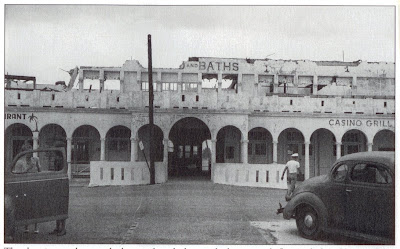
That's where we are introduced to the term "reconstruction." This is the definition of the term as contained in our historic preservation ordinance and the Secretary of Interior's Standards for Historic Preservaiton.

Reconstruction: The act or process of reassembling, reproducing or replacing by new construction the form, detail and appearance of a property and its setting as it appeared at a particular period of time by means of the removal of later work or by the replacement of missing earlier work or by reuse of the original materials.

Let's say those hurricanes in the late 40s destroyed the building so that it was leveled - no evidence of it remained at all. You could then reconstruct it exactly as it was at a certain earlier point in time - but with all new materials and construction. It would not be considered reconstruction if it didn't re-create a version of the building that existed back at one point in time. So, even this term is not appropriately used for the current proposal as it represents a building that never existed. It emulates the building, but it is larger and the relation of the various details is not the same as any other version that existed on this property. Again, the "new" beach casino building has more in common with new construction than historic preservation.

The third "R" of historic preservation is "rehabilitation." This is the definition of that term as contained in the same sources:

Rehabilitation: The act or process of returning a property to a state of utility through repair, remodeling or alteration which makes possible efficient contemporary use while preserving those portions or features of the property which are significant to its historic architectural or cultural value.

The current proposal probably comes closest to this definition. But still, this proposal is not "preserving those portions or features of the property," instead it is creating new ones to look like old ones. If you only look at the surface of the new proposed building, it is essentially all new materials. What is being preserved are some of the structural components of the existing building and, in effect, "icing" is being poured over what portions of the existing structure are salvageable. I am also not convinced that the new proposal has been designed from the inside out. Do we really know that its functionality in 2009 with contemporary retail and restaurant tenant needs have been adequately addressed?

So be wary when you hear some vocal people talk about this "new" proposal as being a restoration that is restoring the casino building back to its 1920s heyday. What it does represent is a tenant-driven project made possible through the local political process. And, really, who is to say that Greater Bay themselves couldn't have done a "restoration" project like this either here or somewhere else on the property?

Next, in Part III, I will examine Commissioner Jennings' renown PowerPoint presentation where she called for a 160 foot setback from the seawall. Funny how now she thinks it's o.k. to extend the building 12 feet further toward the ocean. More later.

Friday, May 25, 2018

2018 Lake Worth Historic Preservation Awards Ceremony at the Lake Worth Casino Ballroom.


The awards were given out last Wednesday evening (May 23rd). More information and images are below along with a message at the end of this blog post from Aimee Sunny, the City’s Preservation Planning Coordinator.

Announcing the ceremony, from a City
press release last month:

“The City of Lake Worth Historic Resources Preservation Board is pleased to announce the City’s second annual Historic Preservation Awards. I hope you’ll join us in recognizing the award winners that have contributed to preserving our City’s unique character and the people that helped make it possible. We are excited to continue with the annual awards program as there are many great new projects in the City.”

Quote by Darrin Engel, Chairman of the Lake Worth Historic Resources Preservation Board.


First, hope springs eternal a future historic preservation awards ceremony in this City of Lake Worth will be held in the lobby of the historic Gulfstream Hotel which still has approvals in place for a historic renovation, a new hotel to 65′ and a three-story parking garage. Although there is nothing historic about our Lake Worth Casino at the Beach any longer, what IS truly tremendous is the Ballroom at the Casino and the City officials and staff who overcame so many challenges to make this venue overlooking the Atlantic Ocean such a success:


A unique distinction on the second floor of the Casino Building is a 3,000 square foot ballroom that offers breathtaking views of the Atlantic Ocean with wrap-around terraces and provides a perfect location for weddings, special occasions and other events.


In honor of National Historic Preservation Month and with the theme of “This Place Matters” the City of Lake Worth recognized award recipients in the following categories.


Click on all images to enlarge.
What structures are on the National and City “Register of Historic Places”? That and much more information can be found on the City’s Historic Preservation website.


Here is the agenda distributed showing the location
of various properties that received awards
in the various categories:
“Congratulations to all of the award winners!”


I am pleased to announce the Cottages of Lake Worth, Inc., a 501c3 non-profit corporation, and the group responsible for The Cottages of Lake Worth book, received the “Preservation Champion” award:
Preservation Champion or Organization: “Acknowledges the contributions of an individual or organization to restore and preserve historic structures or building components.”


Here are Yours Truly and Janice Snearer
with our individual certificates.
Janice was one of the earliest and chief organizers
of The Cottages book effort. Her name appears
on the front cover.


Taylor Jones did the photography. Excellent work.
In Memoriam from the Cottages book: “Prior to official publication, our primary writer, Dean Sherwin, passed away. From inception to completion, Dean never flagged in his passion for this project.”

Here is the message from Aimee Sunny last Wednesday night at the awards ceremony:

“This award is being given to The Cottages of Lake Worth, a local 501c3 non-profit organization, for all of their work in supporting historic preservation efforts in the City. The Cottages is the first recipient of this award which acknowledges the contributions of an individual or organization to the advancement, promotion, and support of historic preservation in the City.

The Cottages group published their signature book, The Cottages of Lake Worth: Living Large in Small Spaces in ​late 2016​ in order to highlight and celebrate the hundreds of unique, historic cottage structures in the City. The book was written by Dean Sherwin and Janice Snearer with photography by Taylor Jones.

In addition to their book, the Cottages hold yearly home tours, have installed informational plaques throughout the City, and have produced a walking and driving tour map of cottages in the City, in addition to continually advocating for the preservation and promotion of these unique architectural and cultural gems. Accepting the award tonight is Wes Blackman, the current president of The Cottages​ board of directors​, Janice Snearer ​who was ​one of the authors of the Cottages book, and Susan Nestler, who is accepting the award on behalf of her husband Dean Sherwin, who unfortunately passed away in 2016 prior to the publication of The Cottages book.

Dean was not only one of the authors of the book, but was also a never-ending advocate for the City and the cottage lifestyle. Also receiving awards are Roger Hendrix​ and​ Teresa Miller,* who are not able to attend this evening, but were instrumental in the formation of The Cottages organization and former Board members.​ Lastly, Taylor Jones, who also cannot attend this evening, is being recognized for her photography that makes u​p the greater part of the Cottages book.”


*To learn more about the founding members of the Cottages group click on this link for an article published in Nov. 2013 by former Palm Beach Post reporter Lona O’Connor.

Sunday, October 8, 2017

“Destination Lake Worth”, the 2017 “State of the City Address” and historic preservation program here in our City.

Is Lake Worth really “open for business”? Is everybody reading from the same script? 

Are all the City departments and staff on board with the “Mission” and “Vision” going forward?

If you’ve been following the news of late about the City of Lake Worth’s historic preservation program, many have their doubts the City is really “open for business”.

We’re also in the midst of a housing crisis, the need for affordable housing is a concern for every City in Palm Beach County, but do we have some departments and staff here in the City of Lake Worth creating our own “affordability crisis”? Let’s say a young family with one or two kids wants to be part of our vibrant community, live in and be part of a historic district in Lake Worth? It’s an attractive idea for many families.

But are they being squeezed out of the market due to expected home repairs and improvements much more expensive than in places not in a historic district? And a cumbersome process as well with hours of paperwork which few really understand. Greenacres doesn’t have historic districts. Neither does Boynton Beach and a lot of other cities.

Remember, these are people who read the paper, this blog, and maybe heard about what happened at City Hall on August 16th from a Realtor or somebody very concerned about all of this. A lot of people are very concerned.

This is not what we were all expecting after two
very well-attended and well-publicized meetings
at the Lake Worth Casino:

View of the “Destination Lake Worth” event held at
the Lake Worth Casino on October 10th, 2016.
“Destination Lake Worth”, a public forum for property owners and investors. The City is “open
for business” and investment in the City “is a
good idea whose time has come”.

View of Mayor Pam Triolo’s State of the City Address 
on January 1st. 2017.
“It is now time to join together and own a period
of time that will be looked back upon by future generations as one of success, responsibility, accountability and positivity . . . the State
of your City is good.”

It’s not a consistent or understandable City message when on the one hand the City of Lake Worth is “open for business” and on the other hand the public here is, “crying for some type of relief ” from the Historic Preservation program and staff, and then an elected official recently saying about the program, “We need to clean up this mess . . . we have egg on our faces.”

Whether you like it or not, the City’s Historic Preservation program and how the City is conducting business is now an election issue. And a big one.

The problem seems complex, but it’s not at all.

The answer is “Customer Service”. The City’s residents and business community are the “customers” and the City’s job is to provide the “service”. However, in a lot of people’s minds, e.g., the latest kerfuffle over the Historic Preservation program, the customer service model is not working and the residents and business community are not being served properly.

However, there is another much more troubling part of all this no one is talking about. Well, no one is talking about at the moment. And that’s how all this delves into the “housing crisis”. You see, on the one hand the City of Lake Worth promotes itself as an affordable “destination” — more so than the more prosperous coastal communities — but those who wish to live “affordably” in a Lake Worth historic district find that increasingly difficult if not impossible. 

Many families, and especially so Millennials with children (or planning to have a family), are priced out of living in a historic district. And that’s ironic because those who promote historic preservation acknowledge we need future generations to appreciate the history that preceded them. How better to appreciate history than to grow up surrounded by history as a young child?

Take note. Draw your own conclusions: No historic districts have ever been created in any neighborhoods west of Dixie Hwy. in the City of Lake Worth.

And if the Historic Preservation program continues the way it’s going, we never will. Because everyone will know it will bring with it a whole lot of problems and won’t be affordable anyway. So what’s the benefit?

But once again, all of this could have been avoided in the first place if there was a less zealous approach to historic preservation, understanding the City of Lake Worth is much different in many ways from neighboring cities like Palm Beach and West Palm Beach too.

And that’s what is really sad about all this. We never had to get to this point when people are asking me, “How can a city get rid of historic districts?”

Also, besides the aspect of affordability, there’s the issue of safety as well. From NBC5/WPTV reporter Alanna Quillen, “Lake Worth neighbors hit roadblocks in upgrading historic homes against hurricanes”.

LAKE WORTH, Fla. — We still have about five weeks left in hurricane season, five weeks left of fear for some homeowners that a storm may significantly damage or destroy their most important investment. [emphasis added]
     If you think its costly to secure your own home, people who live in homes designated as “historic” face not only cost, but also red tape.
     Anthony Marotta and some of his Lake Worth neighbors want to protect their treasures from hurricanes but history and beauty comes with a hidden cost.
     Marotta, who serves as president of the Parrot Cove Neighborhood Association, lives in a 105-year-old home but because the home has been designated “historic”, he has faced some roadblocks in installing storm shutters.
     “Things that should be very simple such as hardening ones homes against hurricanes, we’re being hamstrung by decisions people made 100 years ago,” he said.

Thursday, May 3, 2018

Big changes are coming to historic preservation in the City of Lake Worth.


Last week (Thursday, April 26th) was the City’s public meeting about the “Historic Preservation Design Guidelines” held in the Ballroom at the Lake Worth Casino. If you weren’t able to attend but would like to learn more about these design guidelines for historic structures in the City here is your contact information:
  • Mark E. Stivers, AICP, Assistant Director for Planning & Preservation: Call 561-586-1617; email: MStivers@lakeworth.org
  • Aimee Sunny, Historic Preservation Coordinator: Call 561-586-1690; email: ASunny@lakeworth.org

And much credit goes to Dana Little from the Treasure Coast Regional Planning Council for helping the City of Lake Worth through this process and to consultant Kathleen Kauffman from KSK Preservation who were both part of the presentation.

There are three videos total of this public meeting.
Here is the first one:

To watch video #2 click on this link.

For the final video use this link.


 One of the display tables with information:
“Since adoption [in 1996], Lake Worth has designated six local historic districts and four structures significant to the local history with
several recognized by the National Register of Historic Places.”


More photos and information gleaned
from this meeting. . .


Here’s a view from the 2nd floor of the Casino building
(click on image to enlarge):
Poor design. Because parking was not adequately addressed during the planning in 2008–2010 cars still park in the bike lane. Just one of many items overlooked during the ‘renovation’ of this structure.


However, the City staff at the Casino must be commended for rising above all the deficiencies and they continue to make lemonade out of lemons.
To learn more about Casino building and staff at this complex click on this link. To schedule a tour call Emeric Jeancome at 561-533-7395 or by email: ejeancome@lakeworth.org

Do you remember when the ‘renovated’ Casino was turned over to the City in 2012 and all the problems and deficiencies that were later discovered? Just one of those issues was water leaking into the building.


“But it’s only a problem when it rains!”
The architect and construction company have completed “the fix”. Soon enough we’ll know how successful these repairs are when the Rainy Season begins.

A view of the presenters and public in the Casino Ballroom:
Hopefully our City Commission will stay focused on the priorities and not be distracted. The turtles on the Beach are doing just fine! It’s the residents of this City everyone should be focused on and having this Beach property realize its true potential.

Thursday, July 7, 2011

A response to the "other blogger" from the "other blogger..."

The "other blogger" cites the following from RFQ for the Casino Rehabilitation project:

"The successful firm will demonstrate a clear understanding of the cultural and historical importance of the siteas well as an understanding of the importance of the site to Lake Worth Residents. The selected team will develop an innovative design that captures the renewed spirit of Lake Worth that is truly unique in the Palm Beach area."

That was from the RFQ that went out on our Casino rehabilitation.

In the RFQ it states: Debate regarding the preservation of the Casino Building versus the redevelopment of the site by commercial developers has been controversial and divisive in the community, and has been a major factor contributing to the building’s current state of disrepair. After many years of debate and dialog, the City has decided to redesign and rehabilitate the current structure.


Let's talk about what "rehabilitation" of a structure really means. Click here for a link to the Secretary of Interior Standards for Rehabilitation.  This is how "rehabilitation" is defined:

"Rehabilitation" is defined as "the process of returning a property to a state of utility, through repair or alteration, which makes possible an efficient contemporary use while preserving those portions and features of the property which are significant to its historic, architectural, and cultural values."

AND...

As stated in the definition, the treatment "rehabilitation" assumes that at least some repair or alteration of the historic building will be needed in order to provide for an efficient contemporary use; however, these repairs and alterations must not damage or destroy materials, features or finishes that are important in defining the building's historic character. For example, certain treatments--if improperly applied--may cause or accelerate physical deterioration of the historic building. This can include using improper repointing or exterior masonry cleaning techniques, or introducing insulation that damages historic fabric. In almost all of these situations, use of these materials and treatments will result in a project that does not meet the Standards. Similarly, exterior additions that duplicate the form, material, and detailing of the structure to the extent that they compromise the historic character of the structure will fail to meet the Standards.
ca 1922 column formerly part of west facade which consumed hours of Commission mtg. time.
We already know that the building has been deemed structurally unsound and that the demolition taking place now is designed to remove those deficient parts, that in the judgement of a building official, do not meet current code standards.  That, as we have seen from the demolition plans, amounts to 90 percent of the former building. BY DOING THAT WE ARE LOSING THOSE PORTIONS AND FEATURES OF THE BUILDING WHICH ARE SIGNIFICANT TO ITS HISTORIC, ARCHITECTURAL AND CULTURAL VALUES.  There is nothing of historical, architectural or cultural value that is being saved - an unadorned section of a wall is just what it is - it has no historic value.  The building that was there before the demolition started did have historic, architectural and cultural value.  What the city is getting is a NEW building which will have a vague resemblance to that which has gone before !

Thus, we are going against the stated purpose of the RFQ without any recognition of this change from our elected officials or city administration, or for that matter, the "other blogger."

Sunday, June 10, 2018

OMG! PARKING! Where will everyone park if the Gulfstream Hotel restoration and property development begins?


Some residents in the Downtown are getting riled up again over The Parking! available in the Downtown. So before this gets to the “Houston, we have a problem” stage, find out how the Casino and the Beach can be part of the parking solution without the Beach being part of the actual overall plan in the future vis-à-vis the Gulfstream Hotel renovation and construction of a new hotel on the empty western lot.

Parking was one of the big issues when a developer no longer associated with the Gulfstream Hotel tried to make the Beach property part of the overall plan to restore this historic hotel. That effort, if you recall, did not go over with the public very well. Remember the meeting held by Hudson Holdings in 2015: “Better Beach. Better Lake Worth. Better Life”? But things did not get better from that point.


Following that meeting in
the Lake Worth Casino ballroom. . .


Historically, one of the most vexing problems with the Gulfstream Hotel when it was open for business, was parking. Use this link for a short explanation. A parking garage would solve that problem and those zoning approvals were allowed once already. But I digress.

Back when the municipal pool at the Beach was still open would use the pool 3–4 times a week, mostly on my bike and sometimes by car, arriving around 10:30 or so. During the weekdays that would be when the photo (see below) was taken. The weekdays make up 71% of the week.


Sorry, don’t want to be laborious here but we have to talk some people off the ledge. So please be patient.
View from the Casino complex looking west
during an average weekday.

The above picture is of the lower parking lot on the western side of the Casino property. Whilst the smaller, top portion is usually close to full with cars (people eating at Benny’s or making the hike to one of the Casino building spaces) the lower parking lot is mostly empty during the typical weekday. From the site plan, that amounts to about 416 parking spaces, creating a sea of asphalt for would-be automobiles that would occupy these spaces if there were demand for them on weekdays.

I think we can all agree a mostly-empty parking lot represents a lost revenue opportunity, regardless of how you choose to look at “the numbers” that make up the Beach Fund. This Casino parking lot could be the parking for the Gulfstream Hotel to accommodate construction workers, Gulfstream employees, and many others freeing up parking in the downtown.

A shuttle could pick people up but many might just walk over the bridge since it’s a relatively short walk anyway. And the Gulfstream owners, of course, would pay the City for the privilege of using this parking area especially for the convenience of their employees.

Hopefully, when the Gulfstream Hotel project moves forward there will be many ideas on how to solve the parking issue, if any do arise, and the Casino parking lot is just one idea. All it takes is cool heads to prevail and look at opportunities and possibilities instead of the first reaction always being a near panic. Another potential solution would be the addition of one more level of parking on the parking structure proposed for the Gulfstream Hotel redevelopment, the last approval if I recall correctly, left open that possibility to add more levels later.

And finally, you may be asking yourself this question: “Why is the Casino parking lot so large and so empty most of the time?” Good question.

Much like parking lots of shopping malls all across our nation, this space was built for “peak demand” times. The problem is that represents only 29% of the time, a generous estimate on a weekly basis. Add to that the lower level parking being too far from destination uses, the pier and the Casino building itself, you have a situation where people may make the choice, while deciding where to go for lunch or breakfast, they don’t want to mess with the parking at the Beach, having to pay for it and then walking uphill (in the hot Summer!) for the “privilege” of going to the Beach.

There are so many other restaurant destinations in our Downtown many residents and visitors would find more preferable than the hassle of going to the Beach. And unlike the Casino — almost all of our Downtown restaurants have free parking nearby — both free parking lots and free street parking as well.

I hope that helps explain things. And imagine this, there’s more progress to report!

Made it through an entire blog post that brings up the Casino and didn’t once mention the prior City administration that got us all into this mess in the first place and didn’t bring up the Greater Bay plan either, you know, the plan that included a parking garage at the Beach.


The public was never allowed to examine this plan
for the Beach and Casino. Heavy Sigh.
This plan tackled the fundamental flaw all along:
A Casino structure at the Beach should occupy the center of the Beach property, not to the north where the structure is presently located.

Saturday, January 2, 2016

From the Post: City's Casino is "historic" again (?), more on THAT lottery ticket "in western Lake Worth", and where did that plane crash?

This year-in-review 'news' is on the heels of The Palm Beach Post's editorial page referring to the South Florida National Cemetery "in Lake Worth" which isn't in Lake Worth. The zoning map of the City is readily available using this link and the City's Wikipedia page is more accurate then the information the paper has access to. For instance, the editor's might be interested in this from the Wiki page: "The main campus of Palm Beach State College is located in unincorporated Lake Worth."

The editors at the Post don't do reporter Kevin Thompson any favors in this 2015 year-end review of the goings-on in Greenacres and Lake Worth (the two cities the reporter covers). Two of the big highlights didn't occur in either city.

The unclaimed $15 million lottery ticket sold at "Morrison Avenue east of Military Trail in western Lake Worth" wasn't in "western" Lake Worth. That location is outside the City in unincorporated Palm Beach County, or if you prefer, suburban Lake Worth. And the plane crash "just east of the Lake Worth Drive-In" is also located east of Greenacres, south of Palm Springs, and north of Atlantis. But, again, the Lake Worth Drive-In is not in Lake Worth:
The Lake Worth Drive-In is located a stones throw from Palm Springs and not near "western Lake Worth".
And the Lake Worth Casino building is "historic" again according to the Post:
Our new "charming" Casino was constructed on the site of the former historic structure (which was 94% demolished).
The Gulf Stream hotel is indeed a historic structure. Our newly "renovated" Casino is not. Somewhere in that pile of sand in the image above is what remained after the original building was mostly demolished. This is what I refer to as "the big lie". The Casino complex is a miserably failed project but the "visionaries" who pushed it through will never accept that truth. Who exactly are those "visionaries"?
The people in the photograph above aren't laughing any more. And neither are the City's residents who are left with the huge bill.
Here is another line from the City's Wiki page:
Several geographical features in Palm Beach County somewhat confusingly share the name "Lake Worth."
The Palm Beach Post, our paper of record, isn't doing much to help end this confusion. If anything, they're making it worse.

Wednesday, March 28, 2018

News from The Lake Worth Herald: “Lake Worth Opens Historic Preservation Nominations”.


To see the latest front page news in
the Herald click on this link.
And for the latest community news, events, club meetings and much more click on this link to become a subscriber or pick up the print edition at the City’s newsstand located at 600 Lake Ave. in Downtown Lake Worth. The Herald is still just ¢50!

Without further ado. . .

The City of Lake Worth Division of Planning, Zoning and Historic Preservation has opened nominations for the second annual Historic Preservation Awards Program.
     Members of the Historic Resources Preservation Board will judge each entry on its merit and an awards ceremony will take place in the Lake Worth Casino Ballroom during National Historic Preservation Month, on Wednesday, May 23.
     The following five categories are open for nominations:
  • Rehabilitation/Restoration: Acknowledges the compatible rehabilitation of a structure or building component.
  • Compatible New Construction or Addition: Acknowledges designs that are compatible in massing, scale, size, and architectural features within a historic district.
  • Preservation of Historic Materials: Acknowledges the preservation of historic character defining features.
  • Preservation Craftsman: Acknowledges the contributions of an individual or organization to restore and preserve historic structures or building components.
  • Preservation Champion: Acknowledges the contributions of an individual to the advancement, promotion, and support of historic preservation within the City.

Very important: All nominations are due by 4:00 p.m. on Monday, April 2nd.

For further information contact the City of Lake Worth’s Planning, Zoning and Preservation Dept. at 561-586-1687 or to contact the staff by email click on this link (email addresses in the right-hand column).

Sunday, February 14, 2010

Reactions to architect presentations on the Casino building...

Click here for link to City website for .pdfs of the PowerPoint presentations made yesterday.  Not all of the links are working as of 3:30 p.m. Sunday afternoon.  Maybe staff is still working on them, so you can try back later for the ones you can't access now.  They also videoed, in digital format, all of the presentations and questions asked by Commissioners.  Those are also supposed to be available on line sometime.  Thank you staff for making the special effort to video these - let's just hope everything worked the way it should.

First of all, these are just my opinions.  They really mean nothing more than that - my opinions and $2.10 gets me an extra large black coffee at my local Dunkin' Donuts.  I offer these opinions as I care about the future of our beach and would actually like to see the city be successful in making the beach an attractive destination once again.  The beach is the most valuable property in the city - in financial terms and our social history.  It offers recreational opportunities for everyone regardless of class, race, place of residence.  In the city's almost one hundred years of existence, it has reached the status of a local legend.  The complications in doing anything there have really carried on the legend and give it a life of its own.  Whatever the city ends up doing there - with the property and the building - will affect the "brand" or "image" of the city of Lake Worth.

Interestingly, the Hollywood sign in Hollywood, California is going through a challenging period.  While not as famous perhaps internationally as the Hollywood sign, the Lake Worth beach shares a similar importance to its community.  The beach is a large part of our identity.  Right now, there is a proposal potentially to develop the land around the Hollywood sign - which would alter its appearance at a minimum and perhaps call for its ultimate removal.  There is an effort underway to preserve the land through acquisition by a land trust - thus insuring its continued iconic status. Whatever ends up happening on our beach, has to be of an iconic quality.  If it isn't, it is almost worth not doing anything at all.

So that is why the selection of the firm that will be responsible for the design of our updated Casino building complex is so important.  My opinions here reflect my experience in dealing with architects in my professional life and some of the complex projects with which I have been involved.  I'm not going to go into great deal in describing the strengths and weakness of each response to the RFQ.  What I plan to do here is just separate the respondents into two groups - a top tier and a bottom tier and then list a few reasons why and why not they are part of the group.  The top tier would be those that if I were in decision making position, I would like to pursue further and ask for a more definitive proposal.

By the way, the large white elephant in the city's living room, that no one really talked about yesterday, is just how the city is going to pay to get this project done.

Top Tier - in order of presentation.

REG - I worked with Rick Gonzalez and his firm while in the employ of Mr. Trump at Mar-a-Lago and Trump International Golf Course.  He did a good job for us, under some complicated situations and with the close scrutiny of historic preservationists.  He and his firm have proven themselves with other historical sensitive projects (The Harriet and CityPlace, 1916 Palm Beach County Courthouse.)  He has also worked on many local government projects and is used to that environment.  The only weakness in his proposal related to the Casino building is that the initial renderings show more of a historic wrap-around.  I don't favor this approach in terms of a pure historic preservation perspective.  For that reason, REG does not represent my clear cut top choice.

Beilinson/Gomez - This firm is based out of Miami and has done a lot of work in the South Beach area.  They are very familiar with working in a historically sensitive environment.  They have had some local work as well and experience in Lake Worth with the Gulfstream Hotel.  Their proposal, which includes the restoration of the two story "International Style" existing portion of the building and a re-creation of the 1922 architecture in the location that it originally inhabited, is the "purest" in terms of adhering to the Secretary of Interior Standards for Historic Preservation.  The two buildings would be linked by a modern (2010) glass cube which would add our contemporary stamp to the project and signal that work was done purposefully later in time to show the progression of buildings in this location.  The glass enclosure could also be a display area for a historic timeline showing ancient history of the land through to the present day.  This ties as my overall favorite approach.  It would make an iconic statement that the city of Lake Worth takes historic preservation seriously and we are willing to demonstrate on our most important property.  It would also be able to avail itself of some sort of grant funding.

Living Designs Group - Headed by Lake Worth resident John Szerdi, runs his Lake Worth based firm and is known for his accomplishment of the EcoCentre in downtown Lake Worth - among other super green projects.  His approach takes the existing building as a form and would create what he referred to as an exoskeleton.  Many green techniques would be employed to conserve water, generate energy and capture heat.  I wish the link was working for his presentation on the city's website since it contained full elevations of the building after the eco-treatment.  The two story portion would contain a lot of glass area and would change appearance throughout the day as the sun moved and environmental conditions changed.  It would be an iconic statement of the city's focus on conservation and unique ways to make the built environment softer its impact to the Earth.  This is the other approach that ties with the previous as my most desirable.  It would also be a potential magnet for grant funding.

Zeidler - A large international firm with a lot of varied experience, Zeidler designed the Port of Palm Beach Terminal Building and was the architect for the Kravis Center.  Their approach would be worth following if the city chose to preserve the existing International Style architecture.  In the process, they would open up the west side of the building - as many architects discussed the need yesterday - to be inviting to the public and create a pass-through in the middle of the building.  They have a great reputation and a sound team - I just think that Lake Worth has never really wrapped its arms completely around the existing style and, without much different than what is there today, I am not sure it is worth doing.   But, again, it depends on what direction the city wants to follow.

Song and Associates - A West Palm Beach firm with a full resume of public projects, including the West Palm Beach City Center, is one of the few firms that addressed the staging issue related to this project.  We have a set of existing tenants that will need to operate while the construction is going on - including John G's restaurant.  Their solution would be to keep the restaurant operating in its current location and construct another building immediately to the west. When that building is finished, the restaurant would move and that formerly inhabited portion of the building would be demolished, making way for a rather large plaza area.  south of the plaza would be the continuation of the existing building.  The firm showed flexibility in the style choice and the two-buildings could even lend themselves to different architectural treatment or not.  I am suspicious of their low cost estimates which is of some concern.

The others - in order of appearance.

Architectural Dimensions - I appeared in the Commission Chambers about halfway through their presentation, so I may not be getting the whole story.  They prefer an early 20th Century architecture in the Med Rev vein.  It seemed that they didn't have a lot of experience in historic preservation-related projects.  Their design included some awkward elements - especially as it related to the arches along the pedestrian colonnade.  With the rest of the competition, they just didn't measure up.

Donaldson Group - They came across as knowledgeable and had experience with historic architecture.  Their submitted design, while well-thought-out, ended up with an unattractive building.  At the end of the day, after spending the amount of public money that this project will represent, we need to end up with an attractive building.

Gestalt - A firm headed up Lake Worth resident Manuel Occhiogrosso, Manuel also sits on the Lake Worth Planning and Zoning Board.  I appreciated someone involved with the city throwing their hat into contention for work on our most important property - it recalled Edgar Wortman - City Commissioner and architect of the current version of the Casino building.  His response contained some good ideas but did not stand up to the other respondents.

West Architecture - Another Lake Worth firm - they tended to emphasize their historical consultant's experience with other projects more than how they would use that experience and apply to our situation.  I'm also curious about some of their conclusions related to preservation.  Short on details related to the overall project.

David Godwin - I got absorbed by their analysis working up to their response and ultimate design - but then they lost me on the result.  I like the notion of a gold dome - but the overall style and scale of building just didn't do it for me.

RS Architects - Two person team that I didn't think had the horsepower for this type of project.

Slattery and Associates - This firm presented three options based upon three eras of the building's history - 20s, 30s and 40s as either/or choices.  The Commission started falling all over themselves about how great it was we weren't demolishing the building and being green in the process with this one.  What they didn't realize  is that this firm's response included going back to the original size buildings (much smaller) of the 20s and 30s - which would require demolition of the remaining southern portion of the building - and substantial demolition of the existing building on the north end.  This made me skeptical.

BRPH - This is the firm that we have seen before and worked with the city, the tenants and others to come up with a throwback 1920esque design.  This is achieved by skirting the building with another colonnade area.  In so doing, they create some nice second floor deck area.  They also double the size of the ballroom.  But the delicate columns don't fit the massive scale of this building - bigger than whatever preceded it - and much bigger than the 1920s version.  I highly doubt this would be eligible for listing as a historic structure - as I have said here before.  The architect responded that they would apply for a historic designation - whether it is accepted is out of their control.  Doesn't inspire confidence.  The end result is a sort of "battleship" looking structure.  Of all of the responses, this one qualified as the most political.

Thursday, October 11, 2012

More from Tuesday night's (10/9) City Commission work session on the Casino building...


Other revelations from that meeting:

  • "The building was unsafe and falling down" - according to Rick Gonzalez.  He said that they left 25% of the building.  The Office of the Inspector General said that 4% was left.  The OIG's opinion was not mentioned during the meeting or their recommendation that a code analysis needed to be performed to see if the designation of the project being a "substantial improvement" - above 50% of the total value of the project - triggered other code requirements.  This is where the need for an "armoring device" comes in.
  • "The seawall is not in our scope." REG.  Bornstein: "That is a Mr. Biggs (Mock/Roos) question." 
  • The pool and pool building are "condemned."
  • The casino building only had one electrical meter - meaning John G's or the former tenants weren't charged for electricity.
  • Pregnant pause after the question was asked, "Does the city have control of the building now?"
  • Willie Howard was there all during this meeting and the Palm Beach Post has not published anything about this meeting.  If a tree falls in a forest and no one reports it, did it make a noise?
  • The architect represented, in response to whether or not the project was "historic" - he said that the building was "close" to what was there at one time, that he was an expert and could make that claim.  Last night, at the Historic Resource Preservation Board meeting, I reminded those present that the building that WAS there WAS "historic."  In fact, a designation report done on the 1949 version of the building was worth designation on the National Register of Historic Places.  It never was designated.  What is there now is a new building and meets none of the Secretary of Interior standards for historic preservation.
  • The condition of the seawall and whether it qualifies as an "armoring device" required by the Florida Building Code remains an unasked and unanswered question.
  • The pool structure was included as part of the total project appraisal of value - but no work was done on that building.  It was thought that it was attached to the casino building, but discovered that it wasn't during construction/demolition.
  • More square footage and retail space was considered, but eliminated to allow the project to be built for $6 million per the GMP.